
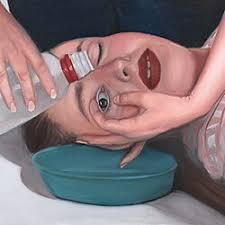
Simply categorizing the album as a smashing, Avante Garde masterpiece would only evade the essence of the work, whether good or bad. There are many elements of the work that would remain unappreciated had this been the route. For instance, the album art. What looks to be a woman with full lips, gappy teeth, and a seemingly healthy eye is made to lie over a bowl and have her eye flushed with… something—hopefully water in her case. The hands which apprehend her are notably feminine, relaxed, professional. The scene is procedural, and she is calm and receptive. She looks at the camera with an eye forced open, centered, vaginal in orientation. The tone of the painting is, of course, surreal, prescriptive, and vaguely demeaning.
This art is hardly peripheral to the music itself. The texture is thin, candid, and unassuming. The guitar, bass and drums are forward and groovy, always laying down a tone for lead vocalist Florence Shaw to say something invariably, unfathomably weird in a soothing voice. If not for the clarity of her vocals, making their content un-overlookable, you might have glossed over them, thinking them to be ornamental. But all the contrary: lines like “And I’m sorry you got attacked by a dog” and “I enjoyed your gig, even though I thought there were spiders all over me” are at the forefront of the production. It is not only that the vocals are the most tone-inducing aspect of the production, but that the lyrics themselves insist on imparting their weird wisdom.
But that’s just the thing: the valley of Dry Cleaning “weird” seems to be very thin in nature. The imagery, storytelling, and tone are BIZARRE to be sure, but they are not so surreal as to completely alienate the listener in the way that Slauson Malone does with his complete unrelenting abstraction. Furthermore, it seems that Dry Cleaning bares resemblance to Snõõper in terms of scope and content, however Dry Cleaning seems to tackle much more complex broad emotions which are much more suited to Dry Cleaning’s more mellow, sonorous, yet charming frame of mind.
Among the most impactful tracks are “Hit My Head All Day,” “Let Me Grow and You’ll See the Fruit,” and “Cruise Ship Designer.” If there is some greater message within a work of this character, it is to be found in tracks like these, with declarative, impressive phrases like “thank you to me for coming” give the entire listening experience, at least for some of the individual tracks, some merit. Such a return from these lines is wanting in justification, but As Slavoj Zizek states, once you can define love, it ceases to exist.
But, all this praise seems to leave us with much inertia, approaching a critical cliff; all above withstanding, one must raise the question: how developed is this sound? That is, the conjunction of the vocals with the off-kilter instrumentation. Without question, the vocals pierce, but the addition of the instrumentation is a little wanting in tone-coherence. The sole listening route for this experience tends to be of great emotional removal from the lyrics themselves, which may be intentional to be sure, but its status as a brilliance is, at the very least, questionable. Take for instance, Shoenberg’s “Pierrot Lunaire,” a staple in Avante garde instrumental performance. Shoenberg finds himself completely freed from inarticulation with his approach to instrumentation. He, trusting his musicians, welds the vocal and instrumental into one, inseparable experience, as opposed to Secret Love, which leaves the listener wishing for the cohesion between the elements, or even complete separation.
Be that as it may, I have never listened to anything like Secret Love, apart from Kim Gordon’s The Collective, which is still a far cry from Secret Love in terms of tone and execution. It is confounding, and I recommend giving it a listen for the sake of conversation. Be sure to sic it on a friend in the car. Excited for the future of this style, and excited for the future in general.
-uu.001